“And Judas (Machabeus) said: Gird yourselves, and be valiant men, and be ready against the morning, that you may fight with these nations that are assembled against us to destroy us and our sanctuary.For it is better for us to die in battle, than to see the evils of our nation, and of the holies: Nevertheless as it shall be the will of God in heaven so be it done." (First Book of Machabees 3:58-60)

The First and Second books of Machabees recount how, in 167 B.C., the priest, Mattathias,refused to worship the Greek gods, sparking a rebellion of the Jews against Antiochus IV who had tried to supplant their religion with the veneration of his own pagan gods. Judas Machabeus and his brothers, sons of Mattathias, continued the war against the subjugation of their homeland and their religion.

In 17th Century Ireland the regiment of Owen Roe O’Neill identified its struggle for freedom of faith and country with that of the Holy Machabees of Old Testament Judea. O’Neill referred to his followers as his Irish Machabeans.

The same war between good and evil, one that has been waged from the beginning of time until now, still rages on. Inspired by the heroism of Machabeus, of Owen Roe O’Neill and their followers, the Irish Machabean is dedicated to resisting all the outrages being perpetrated against the Catholic faith and against the Irish people in our days.

Wednesday, 3 February 2016

“The Labour Party is the moral backbone of the government”

The above title is not so much a joke as a quote from a Labour Party conference speech by Anne Ferris, TD – at least according to an Irish Times article mostly about how Ms Ferris could wallpaper a room with her hate mail. On second thoughts, maybe it is a joke.

By the way, most people who campaign on controversial issues could wallpaper their houses with the hate mail and vicious comments they receive. On some issues feelings run strong, and the debate tends to get heated. We just have to try not to be so thin skinned about it.

But back to the issue at hand, neither of the words “moral” nor “backbone” fit well with the Labour Party.

If the concept of morality still has any meaning, then presenting Labour as a model of it is beyond satire.


Not only did the Labour Party support all the socially harmful and morally objectionable legislative proposals of the coalition government, but in many cases it was the source of them.

Labour policies are still rooted in socialism – an ideology that has been condemned by the Church because, among other reasons, it explicitly rejects the idea of an objective moral order.

The party’s policy on Catholic patronage of schools is an example of this. The Church teaches that there is an objective moral law; that we are obliged to obey it; and that there are negative consequences for ignoring it. And Labour tries to prevent, to the maximum extent possible, that moral law from being taught to school children.

If the crime rates are high today, imagine what they will be like after another generation reared on the socialist idea of morality.

Socialism itself is morally bankrupt. It is a statist ideology, favouring state control in all areas of life, and undermining individual moral responsibility.

So it was natural for the Labour Party to support the so called Children’s Rights referendum, through which the state extended its reach into the private life of the family.

Was it moral for the government to steal €1.1 million of public monies to advocate for one side in that referendum? At least one Labour party minister was peeved that the Supreme Court found against the misuse of these public funds.

Does anyone really consider legalisation of abortion to be the moral solution to crisis pregnancy? Pragmatic maybe, but moral – definitely not! Redefining marriage – and at the same time redefining equality – is another example of Labour Party moral philosophy at work.

And here are some more: taxing the homes of people struggling to pay a mortgage and make ends meet; bailing out wealthy but imprudent investors and making future generations pay the price;
spending vast amounts of money they don’t own in order to build their socialist dream;... the list could go on.

So much for morality and the Labour Party... what about backbone?

The term backbone is usually attributed to people or parties for displaying courage. What courage did it take for Labour to promote its leftist and immoral ideology? Did they have to face condemnation and harassment from international bodies? Did they have to face tremendous opposition from the media?

Perhaps it would have been more accurate for Ms Ferris to have stated: “The Labour Party is the ideological driving force behind this spineless coalition government.”

Wednesday, 27 January 2016

Promises, Promises, Promises


With the announcement of a General Election expected soon, pre-election promises are thick in the air these days.

But what value do they have?

As to be expected, Enda Kenny is getting a free ride in the media in relation to his previous record on pre-election promises, and to the cynicism of his current ones.

Whatever An Taoiseach is promising now, he could have delivered any time in the past five years. But he didn’t.

An Taoiseach Enda Kenny
And he isn’t being taken to task by the media for his failure in this regard. Does nobody notice the contradiction in Mr Kenny’s position?

Right now he is promising, for example, that if re-elected as Taoiseach he will abolish the infamous Universal Social Charge.

He is Taoiseach now. He might not be after the election. So if he wants to abolish the USC, now is the time to do it. He may not get a chance again.

If Mr Kenny thinks that abolishing the Universal Social Charge is the right thing to do, then he should do so now.

Why doesn’t he do it? Why delay it until after the election?

And why don’t the honourable members of the media press him for an answer on this?

Is abolishing the USC the right thing to do? The IMF and the ECB don’t think so. Everyone can have an opinion.

But Enda Kenny apparently thinks it is the right thing to do. And for the past five years he has been in a position to do it, but he didn’t do it and won’t do it until after the election. How strange!

For all he knows, the last days of the present government may be the last chance for years to come to do what Enda thinks is the right thing. But he prefers to take that risk.

Why?

Could it be that right and wrong have no meaning in Irish politics? Is doing the right thing subservient to promising to do it in order to get elected?

The questions raised here about Enda Kenny and his promise to abolish the USC, apply equally to any other promises he might make. Or that anyone in the present coalition government might make.

Then there is the question of Enda Kenny’s past record on pre-election promises.

The one that most readily comes to mind is his pledge, before the last election, to not legalise abortion. 

The Labour Party made no such promise, so at least on that issue they are not guilty of making a false promise.

Was Enda’s pledge just another bit of meaningless blarney to pick up some extra votes? Was it just a cynical use of the lives of unborn children to get himself elected?

Or perhaps it was in the spirit of Pat Rabbitte’s televised admission of lying to the electorate:

“Isn’t that what you tend to do during an election?”

If Mr Kenny’s 2011 pre-election promises were worthless, why should we trust his current ones?

Thursday, 21 January 2016

Refugee Crisis – A Possible Solution?

We might have some sympathy for those who favour mass immigration if they were to lead by example.

Angela Merkel, for instance, could have taken five or ten strapping young men from the Middle East or North Africa into her own home. Then she could have assessed what was involved in accommodating such migrants and, absent any major problems, could have reasonably encouraged others to do likewise.

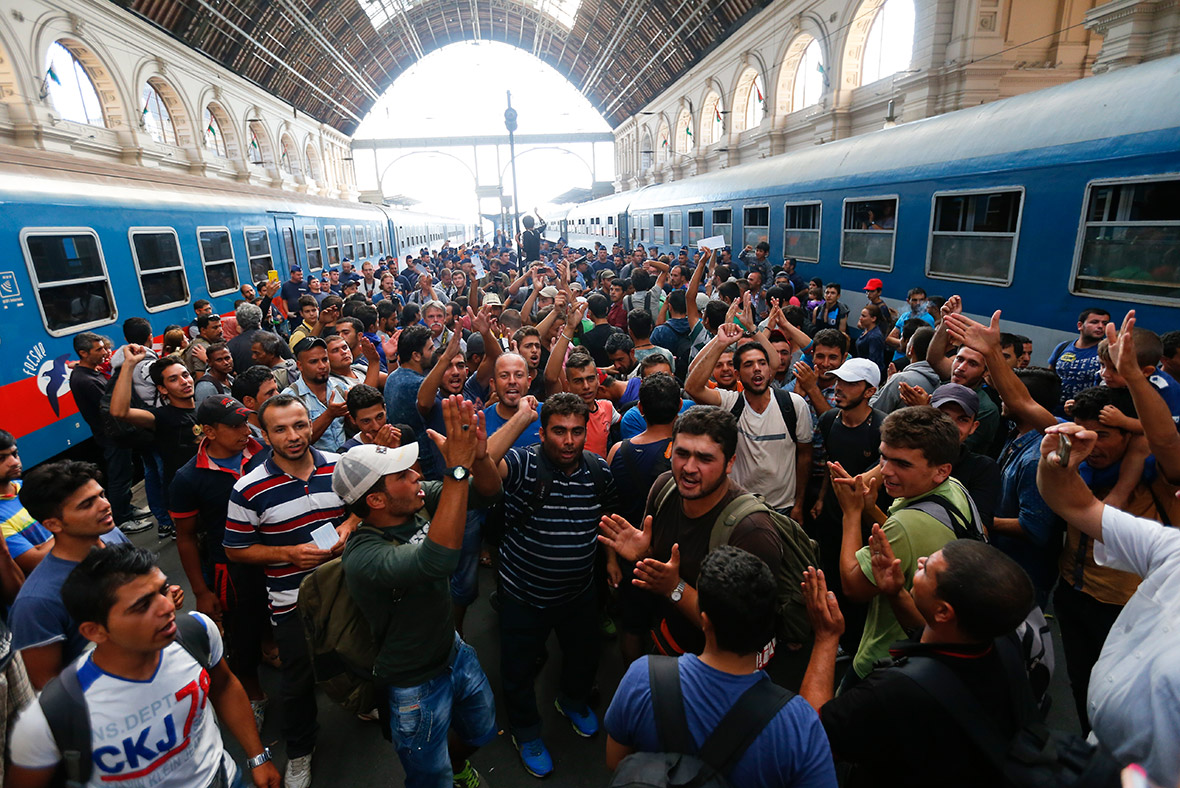
Migrants on route to Merkel's Germany

But quite often those who demand great transformations in society are not the ones that will be most adversely affected by the consequences of the changes they promote.

It is hypocritical to advocate great sacrifices by society when these sacrifices impose an economic and social burden on others, but not on oneself.

To redress that situation Merkel, Frances Fitzgerald, Enda Kenny, and the like, could take refugees into their own homes, at no cost to the exchequer, and as an example to be followed by the masses.

Not just politicians. Journalists and other commentators and campaigners who want lots of refugees and migrants moving into Europe could show their sincerity by welcoming some of the migrants into their own homes. And the clergy too, could provide accommodation for refugees, since so many of them are among the most zealous supporters of open doors immigration policies.

Here in Ireland we are pledged to take in 4,000 refugees. Surely there are at least 4,000 campaigners for liberal immigration policies among the political and media elites, as well as in the organisations that are so quick to berate the rest of us for being mean spirited towards these throngs of young men on the move from muslim lands.

Such a high proportion of the population – so we are told – support mass immigration, that surely it shouldn’t be difficult to find 4,000 who will each accept a refugee. The more enthusiastic campaigners could take in a whole family of them.

Maybe we would end up with many more than the 4,000 for whom we have already signed up. It could run to tens of thousands, or more.

And the best part is that it would be no burden on the State or on the general population. Problem solved! Not even the fiercest opponents of mass immigration could object.

Meanwhile the hosts, kind hearted souls that they are, could prepare themselves to provide exceptional hospitality by studying the religion and culture of their future guests in order to learn how not to offend them in any way – often a difficult task when trying to integrate the competing interests of different peoples.

They could thus learn what their guests’ attitudes and expectations are in relation to women, for example, or to other religions, and could adapt their lifestyles accordingly.

In this way we could accommodate the greatest number of refugees with the minimum possible negative impact on society.

Germany, with its countless refugee welcome committees, could have followed this course rather than making an open invitation to entire regions of the world – an invitation which it recently renewed. In the end they could have welcomed as many migrants as have come, without so much social strife.

Maybe they could even have avoided the mass sexual assaults and attendant government and media cover-ups that occurred in Cologne and other German cities, since the immigrants would have been more dispersed, with less facility to form into gangs.

Why would what we are suggesting have been better for Germany, as well as the rest of Europe? Among other reasons, the idea is rooted in Christian charity, and is dependent on individual responsibility and self-sacrifice.

The alternative, chosen by most governments, is based on statist ideology. The executive authority, insulated from the people it is supposed to represent, decides everything. It dispenses the resources of the country without the consent of the people, and thus deprives them of the supernatural merits that they could otherwise acquire by their own charitable actions.

To those who argue for mass immigration:

Show us your sincerity. Bring immigrants into your comfortable and loving homes, instead of demanding that they be accepted in Europe – accepted and then dumped on a society that may not be inclined to invite huge numbers that they don’t feel up to the challenge of accommodating.


Who knows? Perhaps you could even dispense with the necessity for, and cost of, the frequently denounced and much despised Direct Provision for asylum seekers.

Wednesday, 13 January 2016

Windows of Life and the United Nations

We spent some days in Poland last month. Krakow. And it was cold. Compared to Ireland, very cold.

Outside our accommodation a thin layer of snow on a shed roof and atop an adjacent wall remained all week. It didn’t melt. The temperature didn’t reach above zero during that time.

Even well wrapped up in overcoat, hat, scarf and gloves we felt cold. So, we wonder, how an infant would survive if left out in that harsh climate. Poorly, if at all.

Mercifully, in Poland many convents are reviving a custom that dates back to medieval times, by providing shelter for otherwise unwanted and abandoned babies.

The “Window of Life,” originally called a foundling wheel, and also known as a baby hatch, is an incubator accessible from the street where an unwanted child, or one for whom its mother is unable to provide adequately, can be left in a warm, safe environment, under the benevolent care of the nuns.

Window of Life in Poland

The concept originated in Medieval Europe, under the influence of the moral precepts of the Church.

And so much does protection of the weak conform to natural law that the custom has been adopted by many cultures – even some with no roots in Christian civilisation.

A baby receives medical attention, food and shelter. And the mother can keep her anonymity if she so wishes.

So, all is resolved. Everyone should be happy with this merciful solution to the age old problem of child abandonment.

However, not everyone is happy with Windows of Life. Rather than showing gratitude for the charitable motives that inspire the custom, the United Nations Committee on the Rights of the Child (UNCRC), in a letter to the Polish government, demanded that the Windows of Life be eliminated.

A demand from this committee, or any other branch of the U.N. for that matter, is like the demand of an ill-tempered child for more television viewing time or more ice cream – of itself impotent, but too often heeded out of weakness on the part of the demandee.

Dysfunctional, desperate for relevance, the U.N. has neither the right nor the authority to make such demands. But it makes them anyway.

Fortunately the recently elected Polish government displays little deference towards transnational bodies that interfere in the internal affairs of its country.

Within a few days of assuming office the new government left EU institutions and a Europhile media apoplectic with rage because of its clear indication that it would work for Polish interests – as it was elected to do.

That is an impressive example for some future Irish government to follow. But don’t hold your breath.

Still, we must wonder what hatred inflames the soul of any person or group that would abolish the last safe refuge of an abandoned child.

Would the U.N. committee prefer if the child were abandoned to die of hypothermia?

So it seems.

It is beyond callous. It is diabolical.

Does the committee offer any alternative solution to the abandonment of children?

No. But, concomitant with its demand to abolish the Windows of Life, its demand on Poland to liberalise its abortion laws provides a clue as to UNCRC’s motives.

How will more abortion solve the problem of abandoned children?

It won’t.

Will it even alleviate the problem?

Obviously not.

In a similar demand made a few years ago to the Czech Republic to abolish baby hatches, the U.N. committee cited the right of a child to an identity. So, if we understand them correctly, a baby has a right to his or her identity, but not a right to life.

Since the UNCRC seems to think it better to kill the child than to save it without an identity, does that mean that it will demand, in future, that the identity of aborted babies be respected?

In other words will the UNCRC insist that those who died from abortion get individual graves instead of their dead bodies being dumped as medical waste or used to fuel hospital heating systems?

The real problem that the UNCRC seems to have with Windows of Life is that they provide an alternative to abortion.

Their very existence undermines many of the arguments used by pro-abortionist activists.

Windows of Life clearly diminish the concept of an unwanted child.

With their kind and merciful welcoming of life they show up the abortion industry for its cruelty.

They ensure that the care of a child is never beyond what is possible.

They spare the mother – juvenile, unwed or otherwise – of shame and embarrassment.

It is the pro-abortion lobby that is left with shame. And now the U.N. Committee on the Rights of the Child joins them.

Perhaps this is why they are determined to rid the earth of this charitable and pious custom – because it makes them look bad by contrast. Perhaps it even troubles their consciences.

The UNCRC and other UN bodies have made similar demands on Ireland. Will our government show similar resolve to that of Poland? Or will they show obsequious deference in the face of international demands?

We would be surprised to find anything other than the latter from our present government. But maybe we can elect one in the future that will show leadership and strength.

Meanwhile we wonder how the Irish government will fare under interrogation by the UNCRC tomorrow.

Tuesday, 24 November 2015

Don’t Treat Wolves Like Lost Sheep

The doctrine of Our Lord Jesus Christ is full of seemingly antagonistic truths which nevertheless when examined closely, far from mutually denying one another actually complement one another, forming a truly marvelous harmony. This is the case, for example, with the seeming contradiction between Divine justice and goodness. God is at the same time infinitely just and infinitely merciful. Whenever we close our eyes to one of these perfections in order to understand the other we fall into grave error. In His earthly life, Our Lord Jesus Christ gave admirable proofs of His gentleness and His severity.

Let us not try to “correct” Our Lord’s personality according to the smallness of our views, to close our eyes to the Savior’s kindness in order to better understand His justice; nor on the other hand, to turn away from His justice in order to better understand His infinite compassion for sinners. Our Lord showed Himself perfect and adorable both when He welcomed Mary Magdalene with ineffably sweet forgiveness and when He punished the Pharisees violent language. Let us not tear up any of these pages from the Holy Gospel. Let us understand and adore Our Lord’s perfections as they reveal themselves in both episodes. And finally, let us understand that our imitation of Our Lord Jesus Christ will only be perfect the day we know not only how to forgive, comfort and caress but also to scourge, denounce and fulminate as Our Lord.

There are many Catholics who consider as unworthy of imitation the episodes of the Gospel showing the Messiah's holy wrath against the ignominy and treachery of the Pharisees. At least that is what emerges from the way they consider the apostolate. They always talk about sweetness and always seek to imitate this virtue of Our Lord. May God bless them for that; but why don’t they seek to imitate the other virtues of Our Lord?

Very often, when one proposes some energetic action in matters of the apostolate the invariable answer is that we must proceed with the utmost gentleness “in order not to further alienate those who have fallen astray.” Could one sustain that strong action invariably causes the misguided to “drive even further away”? Could it be argued that when Our Lord called to task the Pharisees with burning invectives He did so with the intention of “driving those misguided ones even further away”? Or should one perhaps suppose that Our Lord did not know or care about the “catastrophic” effect that His words would cause on the Pharisees? Who would dare admit such blasphemy against Our Lord, the Incarnate Wisdom?

God forbid we should call for strong action and verbal violence as the only remedies for souls. God forbid, however, that we should banish such heroic remedies from our methods of apostolate. There are circumstances in which one should be suave and other circumstances in which one should employ holy “violence.” It is always a grave evil to be gentle when circumstances require severity, or severe when circumstances require suavity.

* * *
All this unilateral order of ideas we are denouncing stems from a one-sided consideration of the Parables. There are many people who take the parable of the lost sheep as the only one in the Gospel. Now, this is a very serious mistake that we do not want to shrink from denouncing.


Our Lord not only speaks of the lost sheep, unfortunately bloodied by thorns, which the shepherd patiently seeks out at the bottom of the abyss. Our Lord also tells us about rapacious wolves that constantly surround the fold watching for an opportunity to slip in disguised in sheep’s clothing. Now if a shepherd who knows how to tenderly carry a lost sheep on his shoulders is admirable, what could be said of a shepherd who were to abandon his faithful flock and walk a long distance to fetch a wolf disguised in sheep’s clothing, lovingly take it on his shoulders, open the doors of the fold to it and place the ravenous wolf among the sheep?

However, if they were to apply effectively the unilateral principles of apostolate that they profess, how many Catholics would act exactly this way!

* * *

In order to better understand that the perfect imitation of Our Lord is not found only in meekness and suavity but also in severity we will cite a few episodes and sentences of some saints. A saint is one whom the Church has declared with infallible authority to have been a perfect imitator of Our Lord. How did the Saints imitate Our Lord? Let us see.

Saint Ignatius of Antioch, a martyr of the second century wrote several letters to various churches[1] before being martyred. These letters contain phrases about heretics such as: “ferocious beasts (Eph. 7); rapacious wolves (Phil. 2.2.); mad dogs that attack treacherously (Eph. 7); beasts with men’s face (Smyrn. 4.1.); Devil’s herbs (Eph 10.1.); parasite plants that the Father hath not planted (Tral. 11); crops destined for the eternal fire (Eph. 16.2).”

As we see, this way of dealing with heretics closely followed the examples of Saint John the Baptist who called the scribes and Pharisees a “brood of vipers,” and of Our Lord Jesus Christ Who named them “hypocrites” and liked them to “whited sepulchres.”

The Apostles proceeded in the same manner. Saint Irenaeus, a martyr of the second century and disciple of Saint Polycarp, who in turn had been a disciple of Saint John the Evangelist, recounts that when the apostle went to the baths he withdrew without washing because there he saw Corinth, a heretic who denied the divinity of Jesus Christ, for fear, he said, that the building would came down because in it was Corinth, an enemy of truth. The same Saint Polycarp, meeting one day with Marcion, a Docetist heretic who asked if he knew him, replied: “No doubt, you are the first-born of Satan.”

Moreover, in doing so they followed Saint Paul’s advice: “A man that is a heretic, after the first and second admonition, avoid” (Titus 3:10).

If the same Saint Polycarp happened to meet with a heretic he would cover his ears and exclaim: “God of goodness, why hast Thou kept me on earth to endure such things?” And he would immediately flee to avoid such company.

In the fourth century Saint Athanasius recounts that Saint Anthony the hermit called the speeches of heretics a poison worse than that of snakes.

And this is the way the Holy Fathers treated heretics in general, as can be seen from an article published in Civiltà Cattolica, a journal founded by His Holiness Pius IX and entrusted to the Jesuits fathers in Rome. In this article they cite several examples that I transcribe:

“Saint Thomas Aquinas, sometimes presented as invariably peaceful towards his enemies, in one of his polemics with William of Holy Love, who still had not been condemned by the Church, thus treated him and his henchmen: “Enemies of God, ministers of the devil, members of the Antichrist, enemies of the salvation of mankind, slanderers, sewers of blasphemy, reprobates, wicked, ignorant, equal to Pharaoh, worse than Jovinian and Vigilantius (heretics who denied the virginity of Our Lady).” Saint Bonaventure called Gerald, one of his contemporaries, “impudent, libelous, crazy, poisoner, ignorant, deceitful, wicked, foolish, perfidious.”

The mellifluous Saint Bernard, talking about Arnold of Brescia who led a schism against the clergy and church property, called him: “disordered, vagabond, impostor, vessel of ignominy, scorpion vomited out of Brescia, viewed with horror in Rome, with abomination in Germany, scorned by the Roman Pontiff, praised by the devil, worker of iniquity, devourer of the people, mouth full of cursing, sower of discord, maker of schisms, ferocious wolf.”

In more ancient times, Saint Gregory the Great, rebuking John, Bishop of Constantinople, denounced to his face his profane and abominable pride, the pride of Lucifer, his foolish words, vanity and lack of intelligence.

Nor did Saints Fulgentius, Prosper, Jerome, Siricius Pope, John Chrysostom, Ambrose, Gregory Nazianzen, Basil, Hilary, Athanasius, Alexander Bishop of Alexandria, the holy martyrs Cornelius and Cyprian, Athenagoras, Irenaeus, Polycarp, Ignatius martyr, Clement, and finally all the Fathers of the Church who distinguished themselves by their heroic virtue speak otherwise.

If one wishes to know what rules the Doctors and Theologians of the Church provided to be followed in controversies with heretics, read Saint Francis de Sales, the gentle Saint Francis de Sales in Philotea, chapter 20 of Part 2: “The declared enemies of God and the Church should be vilified as much as possible (provided the truth is respected) and it is a work of charity to cry: Behold the wolf! when it is amidst the flock, or anywhere else it is found.”[2]


How many protests we would have to listen to if Legionário were to publish against contemporary enemies of the Church half of what has been said above!

The preceding article was originally published in O Legionário, on September 28, 1941. It has been translated and adapted for publication without the author’s revision. –Ed. 
The Irish Machabean has republished this article from the website of the American TFP


1.The Letters, or Epistles of Saint Ignatius of Antioch, Father of the Church. Among these letters are those to the Ephesians, Philadelphians, Smyrnæans, and Trallians, mentioned here. ↑

2.Hitherto quotes are from the article in Civiltà Cattolica, vol. I, section V, p. 27. ↑

Friday, 20 November 2015

Immigration: Charity and Common Sense

In the wake of last week’s Paris attacks the topic of immigration has been brought back into the forefront of public discourse.

And as usual left wing liberals denounce as racist anyone with even the slightest misgiving about unlimited immigration.

They don’t explain, nor apparently even notice, the internal contradictions in their own position.

Many people who would prefer to limit immigration are mainly worried about one particular strand of the whole broad spectrum of possible immigrant groups. This particular strand is muslim immigration, and it is mightily defended and continually excused by liberals.

It must be complicated being a liberal these days.


On the one hand, they denounce as misogynist all opponents, however mild, of the feminist movement; to them the least challenge to same-sex “marriage” is homophobic; they think that only an uptight prude would call for modesty in dress or behaviour, and that only a racist would advocate immigration policies being subservient to common sense. They despise militarism.

But on the other hand, the culture that liberals support, defend and tirelessly excuse – islam with its sharia law – has women walking around in body bags, as the private property of their men folk; has homosexuals thrown from high roofs or burnt alive; flays, pours acid in the face of, or “honour” kills immodest women who dare expose to public view as much as an ankle or who bring disrepute upon the male members of their families; and whose spokesmen regularly announce plans to wipe out the entire Jewish race.

Oh, and the leftist liberal pompously declares that all this violence emanating from islam is caused by right wing extremism. Which is akin to using as an excuse, after committing a crime: “The devil made me do it.”

Immigration policy should be based on a combination of charity and common sense.
Charity dictates that, unless there is a grave reason to act otherwise, we should welcome visitors to our shores.

Common sense raises some questions:

At what rate can we accept immigrants, and still enable them to adapt and assimilate to our culture?
What would qualify as an exception to the rule of charity? Should we, for example, accept declared enemies, who have credibly claimed that they will suppress our culture, marry our daughters and supplant our religion?

When it comes to refugees, charity may desire to take them all in, providing food and shelter for those in need.

Of course common sense will ask the perhaps unwelcome questions:

What can we afford to do? How much can we give without impoverishing our own people?

How much can we give now without risking not being able to continue giving, and thus leaving the refugees in another desperate, perhaps worse, situation?


What we give should, ideally at least, be given voluntarily rather than through taxation for three reasons:

-           There is more merit in giving freely than in giving under coercion;

-          Those who disagree with current refugee policies need not support them, while those who strongly favour them can support them abundantly;

-           Governments are not necessarily the most efficient vehicles for administering charity.

Then there is the more controversial question:
Why don’t we send what we can afford, in order to help the victims of the crisis, to their own country? Couldn’t we, in this way, save them the risks, cost and hardships of the journey?

Naturally there are other concerns whose reasonableness was highlighted by the massacre in Paris: security concerns; concerns about integration of immigrants into their host countries.

The left dismisses these concerns as being the wild rantings of right wing lunatics and racists, telling us that the 3,500 refugees that Ireland has agreed to accept will make up less than 0.1% of our population.

That would be a useful statistic if we were dealing with a group of 3,500 people who might be easily assimilated into our society, with a profile that is evenly distributed among both sexes and a wide range of age groups, cultures and religions.

However what we are dealing with is a group with a very singular demographic profile, and one that is largely self-segregating from the rest of society. Its members belong to a religion that is fiercely hostile to the West and to Christianity, and that easily justifies subduing and killing of infidels, not just because the right wing extremists made them do it, but because their holy book instructs them to do so.

Furthermore, according to the United Nations, 75% of the refugees currently migrating across Europe are men. Video footage would suggest that it is even more, and that the majority are young and fit.

But even taking the UN figure of 75%, we would have 2,625 strong, fit, young male members of a religion that is deeply hostile to our culture, religion and way of life due to arrive in Ireland by the end of next year.


Rather than comparing their number to the whole population of Ireland, wouldn’t it be more appropriate to compare it to the numbers in our army? That would be 35%.

Saturday, 14 November 2015

Mass Murder in Paris: the West is betrayed from within

Once again we wake up to hear of carnage on the streets of Paris. And once again the media and political “leaders” of the entire western world are unable to bring themselves to tell the truth about what happened.

A typical example is, not surprisingly, a report in The Irish Times, which goes into much detail about the terrorist attacks leading to the deaths of more than 125 people, without once mentioning islam or muslims. The report even goes as far as to state that Barrack Obama “declined to speculate as to who was responsible for the incidents.” Is that someone’s idea of a joke?

It is because of that kind of reporting, as well as the attitude of western politicians, that terrorism has become synonymous with islam in the mind of the public. But perhaps The Irish Times, Barrack Obama, and the rest of the western media and political establishment are correct. Maybe it isn’t necessary to make the distinction between terrorism and islamic terrorism.

After all, who in the western world is so dumb as to genuinely think that the terror attacks in Paris might have been carried out by anyone other than muslims.

And indeed if they had been, we can be sure that we would be well informed on the matter. It would be almost a cause for celebration among the western media and political elite – a proof of the great diversity and smooth functioning of our multicultural society. Or something like that.

Most people look to their governments to find some sort of solution to this situation.

But, at least in the West, governments are more the cause than the solution of the problem. They, backed by a great proportion of the media, are more responsible for the problem than islam is. Islam is what it is, and we can’t change that. There isn’t even any point in blaming islam.

Judging by media reports and statements from the political elite, we are not even supposed to expect muslims to behave responsibly, peacefully or justly.

The root cause of islamic terrorism in Europe is not what islam is, but the fact that it has penetrated into the heart of Europe, without showing any willingness to integrate with European culture, and taking with it its fiercely supremacist ideology. Not only do our governments and media turn a blind eye to this, but they actively facilitate it, accommodate it, and relentlessly persecute anyone who opposes it.

The establishment in the western world – media and government alike – is contributing to the death of European civilisation with a two pronged attack: while pandering to islam with legislation, easy immigration and financial assistance, those who defend western civilisation are treated as the enemy, are restricted in their ability to do anything about the problem.

Even debating the issue is no longer acceptable in much of the West.

Disarmed by their own governments – both physically and through myriad restrictions, regulations and laws – the western peoples are left as sitting ducks for a declared enemy of our civilisation, an enemy brought in by our governments without any mandate ever to do so.

At the very least the situation raises a question mark over the intentions of our government and media. 
Do they really want to destroy western civilisation, as appearances indicate?